
Blue and Green Corridor Kenya
Rethinking Human-Environment Relations with "Philosophical Anthropology": Evidence at the Blue and Green Cherang'any-Elgon-Nzoia Corridor in Western Kenya
Funding: BayIntAn, 2026 - 2027
How can we rethink the relationship between humans and the environment? Using the Cherang’any–Elgon–Nzoia Corridor in western Kenya—an ecologically highly sensitive region of East Africa—as a case study, this project combines philosophical anthropology with geographical perspectives. At its core is the idea that humans actively shape their environment—and are thus both part of the problem and part of the solution. In the face of deforestation, population pressure, and land-use conflicts, this approach offers a multifaceted view of sustainability that goes beyond romantically idealized notions of nature and purely moral appeals.
- Idiographic contextEinklappen
-


Map of Cherangany Hills Water Tower, Kenya (Source: B. Rotich, M. Kindu, H. Kipkulei et al. 2022, p. 3)
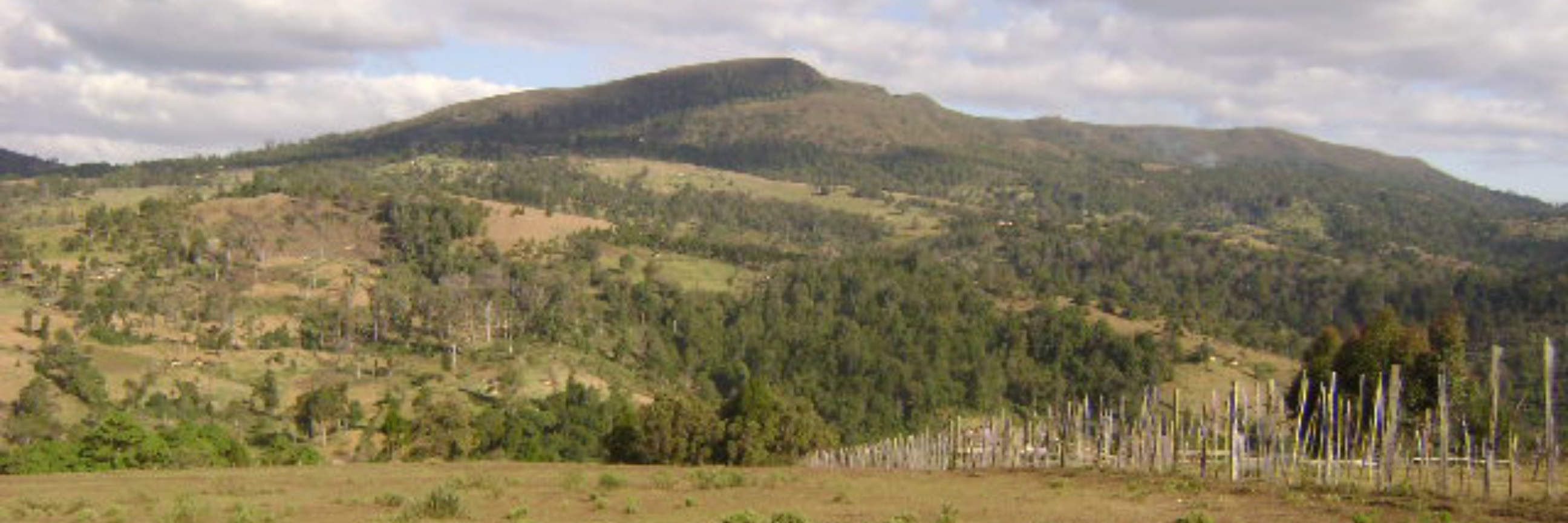
The Cherang’any–Elgon–Nzoia Corridor in western Kenya - with connection to the watershed of Mount Elgon, Uganda - serves as the main “water tower“ for the core vegetation of Afro-montane forests, montane zones, and riverine ecosystems, and both mountain areas are crucial as water catchments of Lake Victoria and Lake Turkana.
The area faces significant deforestation driven by agricultural expansion, illegal logging, and settlement encroachment, threatening critical water catchments. The environmental degradation reduces river flow in the Nzoia Basin, increasing the risk of flooding downstream and water scarcity upstream. Biodiversity is under pressure as forest fragmentation disrupts habitats for endemic and migratory species in the Cherang’any Hills and Mount Elgon ecosystems. The Human population in the corridor is increasing (about 7 million nowadays) and often experiences land tenure conflicts, as communities, government agencies, and conservation efforts compete over land use and ownership. Poverty and limited livelihood opportunities push local residents to rely heavily on forest resources, creating a cycle of (over-)exploitation and ecological decline, while agricultural activities are still the main practice for securing local livelihoods (The Government of Trans-Nzoia 2020).
“The Green”: A recent study analyzing forest cover changes in Kenya’s Cherangany Hills from 1985 to 2020 found a significant decline in forests, mainly due to human activities and environmental factors. Forest area decreased by about 14.1%, while croplands and grasslands expanded, driven by factors like agricultural conversion, logging, grazing, and population growth. The findings highlight the need for improved forest management strategies and targeted restoration efforts in degraded areas (Rotich et al. 2022).
“The Blue”: The Nzoia River rises in the highlands of Cherangany Hills and around Mount Elgon, flows into Lake Victoria, and ultimately contributes to the White Nile system, which forms part of the larger Nile Basin. The river supports millions of people through irrigation and agriculture, and its watershed has been the focus of restoration efforts due to pressures like land-use change and significant population growth.
The selected area can be described as a hotspot of human-environmental relations under societal and ecological pressure, with still high potential for various innovative activities and practices.
- conceptional frameworkEinklappen
-
Photo: H. Fiebig/ 50 Treasures of Kenya
The project aims to “revisit” human–environment relations in geography through the lens of philosophical anthropology, with particular reference to Helmuth Plessner’s theoretical framework (2019). It aims to overcome one-sided approaches - such as naturalistic and social constructivist perspectives - by offering a dialectical and integrative understanding of the relationship between nature and culture (Dörfler & Rothfuß 2023). Central to this perspective is the anthropological premise of “eccentric positionality”, according to which humans, as beings without a fixed natural habitat, are compelled to actively create cultural worlds and shape their environments through social and technological practices. Building on this foundation, the proposed project critically challenges romanticized and idealistic notions of a “return to nature” as well as purely moralistic or ideologically driven sustainability concepts. Sustainability thus emerges as an inherently ambivalent project, not aimed at restoring a presumed natural balance, but at pragmatically managing and transforming human–environment relations (Dörfler & Rothfuß 2026 - forthcoming).
Building on this foundation, the project advocates a theoretical and practical reorientation in human geography that acknowledges the dialectical relationality of nature and culture, while recognizing humans as both drivers of environmental problems and key agents of potential solutions. Such a perspective offers new avenues for geographical and development research, environmental education, and practical engagement with global ecological challenges of the “Anthropos in the Anthropocene” (Bajohr 2020).
- Main Objectives of the Research ProjectEinklappen
-
- Overcome scientific fragmentation between natural and social sciences by establishing the constitutive interdisciplinary approach of Philosophical Anthropology
- Integrative mapping of natural, socio-cultural, political and territorial dimensions of the selected area
- Participatory Action Research as an integrative and innovative tool for fostering self-organising capacities of local communities
- ReferencesEinklappen
-
- Bajohr, H. (Ed.)(2020): Der Anthropos im Anthropozän: Die Wiederkehr des Menschen im Moment seiner vermeintlich endgültigen Verabschiedung. Berlin, Boston: De Gruyter.
- Dörfler, T. & Rothfuß, E. (2023): „Just human“: Eine phänomenologische und philosophisch-anthropologische Perspektive auf unser leibliches Mensch-Umwelt-Verhältnis. In: Geographica Helvetica 78, 223-240.
- Dörfler, T. & Rothfuß, E. (2026): Geographical Human–Environment Relations Revisited: Critical Insights from Helmuth Plessner’s Philosophical Anthropology. In: DIE ERDE. Journal of the Geographical Society of Berlin (forthcoming).
- The Government of Trans-Nzoia (2020): Trans Nzoia County Physical and Land Use Development Plan (2020). ‘Towards an Outstanding Agro- Industrialized Sustainable County with High Quality of Life for Residents’, Kitale.
- Plessner, H. (2019): The Levels of Organic Life and the Human. An Introduction to Philosophical Anthropology, transl. by Millay Hyatt, introd. by Jay M. Bernstein, New York, Fordham University Press.
- Rotich, B. et al. (2022): Impact of land use/land cover changes on ecosystem service values in the Cherangany hills water tower, Kenya. In: Environmental Challenges 8.
- Machado, E. R. et al. (2017): Does forest replacement increase water suply in watersheds? Analysis through hydrological simulation.